Last updated October 16, 2026







Free written scope consultation - allowances, timeline, and change-order rules on paper before a single trade is scheduled
Construction Warning Signs: A West Covina Homeowner’s Reference Guide
Here’s the uncomfortable truth about construction warning signs: most homeowners don’t need a list of every possible problem a house can have. They need to know whether the crack in the stucco above the garage means “keep an eye on it” or “call an engineer before the rainy season.” West Covina’s housing stock spans from 1950s ranch-style homes in Sunset Palms to 1980s hillside builds in Woodside and South Hills, and every era has its own way of telling you something’s wrong. This guide, built from what we’ve seen on hundreds of general contractor projects in West Covina, gives you a severity framework: which signs mean call today, which mean schedule within 30 days, and which mean take a photo, wait a month, and compare.
Quick Answer
A construction warning sign in your West Covina home is any visible symptom that points to an underlying structural, plumbing, electrical, or waterproofing problem. The key is severity triage: a hairline crack under 1/16 inch at a drywall corner is almost always cosmetic, while a staircase or diagonal crack wider than 1/4 inch, a door that suddenly stops latching, or a water stain that grows after rain all need professional evaluation. The fastest way to know where you stand is to call Sawyer Remodel West Covina for a written assessment, or use the severity framework below to make the call yourself.
Styles & brands we work with





Table of Contents
- The Severity Triage System: Call Today, Schedule Soon, or Monitor
- Reading Cracks: Shape, Location, and Width Tell the Real Story
- Water Staining: What Ceilings, Walls, and Floors Each Reveal
- West Covina Vintage Housing: Galvanized Plumbing and Knob-and-Tube Proximity
- What to Document and Send Before a Contractor Arrives
- Seismic and Soil Movement: Why West Covina Homes Crack Differently
- Common Mistakes to Avoid
- When to Call a Professional
The Severity Triage System: Call Today, Schedule Soon, or Monitor
Not every construction warning sign in West Covina deserves the same reaction. Here’s the triage system we use when homeowners send us photos before scheduling a formal visit. It’s simple: Call Today means the problem is actively damaging your home, creating a safety hazard, or will get significantly more expensive within 30 days. Schedule Within 30 Days means the problem is real, needs repair, but isn’t accelerating. Monitor and Photograph Monthly means the issue is likely cosmetic or dormant, and the right move is to document it so you can compare over time.
- Call Today: A ceiling stain that appears or grows within 48 hours of rain, any crack wider than 1/4 inch that you can fit a nickel into, a sagging roof ridge, a door that will not latch or close at all, a musty smell combined with visible dark staining on a wall or ceiling, or any crack that travels diagonally from a window or door corner toward the wall’s base.
- Schedule Within 30 Days: A hairline crack that has been stable for months but you want to confirm, peeling paint on exterior trim with exposed wood, a small water stain with no active moisture, a slightly sticky door, or minor flaking in your foundation’s exposed concrete.
- Monitor and Photograph Monthly: Hairline drywall cracks at wall-to-ceiling corners, minor settling cracks under 1/16 inch in stucco, very faint window condensation stains on painted sills, and nail pops that appear in ceilings during humidity cycles. Take a photo with a ruler or coin for scale, label the date, and set a reminder to check again in 30 days.
This is the framework that stops the panic-Googling and starts a rational response. You don’t need to solve the problem tonight; you need to know if tonight is the night to call.
Reading Cracks: Shape, Location, and Width Tell the Real Story
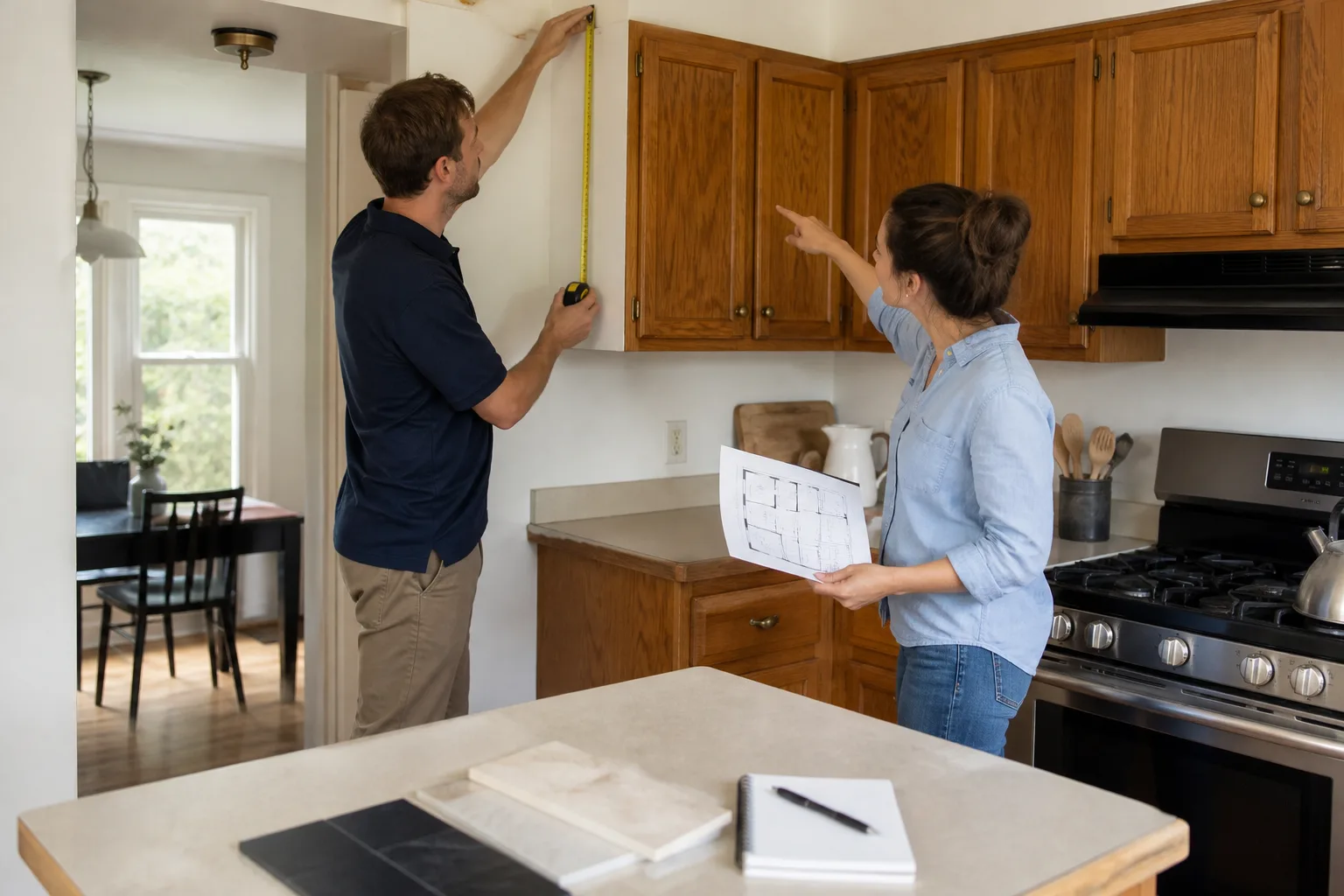
West Covina homeowners see cracks in three main places: stucco exteriors, interior drywall, and exposed concrete foundations. The crack’s shape, location, and width together tell you whether you’re looking at normal settlement or active structural movement. This is the exact framework we walk through on home renovation walkthroughs in West Covina.
Width: The Nickel Test
- Under 1/16 inch (hairline): Almost always cosmetic. Drywall expands and contracts with temperature and humidity; stucco shrinks slightly as it cures. Monitor monthly.
- 1/16 to 1/4 inch: Worth a professional look, especially if the crack is actively changing. This is the range where we see early moisture-related or settlement-related movement in West Covina homes built on expansive clay soil.
- Over 1/4 inch: This is a structural red flag. You should be able to fit half the thickness of a nickel into a crack this wide. Call today. Active widening means whatever force is moving your house is winning.
Shape and Direction
Cracks that look like a set of stairs (“stair-step cracking”) are the most concerning, especially along mortar joints in brick veneer or concrete block. That pattern means the wall is shearing. Diagonal cracks sprouting from the corner of a window or door toward the floor are also movement-related, not cosmetic. A long, vertical crack in a drywall seam is almost always just a failed tape joint. Straight, horizontal cracks in a foundation wall can indicate lateral soil pressure, which is serious in hillside areas of West Covina like South Hills, where built-up pads and slope drainage interact with foundation walls differently than on flat lots.
West Covina sits on a mix of alluvial soil and, in the hills, weathered sedimentary rock. That soil expands when wet and contracts when dry, and the movement is rarely even. One side of your slab may lift half an inch while the other stays put. The result is exactly the kind of crack pattern that sends a homeowner to the internet at midnight. The fix is often drainage correction and cosmetic repair, not a foundation rebuild. But you can’t know that until a professional reads the pattern.
Water Staining: What Ceilings, Walls, and Floors Each Reveal
Water staining isn’t just an inconvenience, it’s a diagnostic fingerprint. The location, color, and shape of a stain tell you where the water is coming from, which is often far from where it shows up. Here’s how to read the three most common patterns in West Covina homes.
Ceiling Stains
A brown or copper-colored ring on a ceiling that appears after rain points to a roof leak, often from flashings around penetrations (plumbing vents, skylights, HVAC curbs). If the stain is directly below a bathroom, the source is more likely a failing supply line, tub drain, or toilet wax ring on the floor above. A stain that grows outward in the shape of a cloud over several weeks usually signals a slow, continuous leak, not a sudden event. In homes with tile roofs common across West Covina, we also see leaks from cracked or slipped tiles after wind events, even when there’s no visible damage from the ground.
Wall Discoloration
Yellowish or tea-colored staining on an interior wall that follows a diagonal line down from a window corner is typically window flashing failure, where the exterior weatherproofing has let water into the wall cavity. Greenish-gray or black speckling around baseboards is mold from chronic low-level moisture, often a slab leak or a plumbing line weeping inside the wall. Bulging paint or bubbling drywall tape on a bathroom wall tells you the leak is behind the surface, not on it.
Floor Warping
Cupped hardwood planks (edges higher than the center) or laminate that’s swelling at the seams in a bathroom, kitchen, or laundry area points to water migrating under the finished floor. In a slab-on-grade West Covina home, this is frequently a supply-line leak in the concrete, and the water travels to the path of least resistance. Tile that is cracked along a line that mirrors a known plumbing run is another red flag. Vinyl plank that’s lifting at the edges can be humidity, but if the lifting persists after the rainy season, assume the worst and call it in.
West Covina Vintage Housing: Galvanized Plumbing and Knob-and-Tube Proximity
Here’s what most generic “home warning signs” guides miss: West Covina has tens of thousands of homes built between 1945 and 1975, and that era came with two specific systems that fail in visible, predictable ways.
Galvanized Plumbing Failure
If your home was built before the mid-1960s and still has original supply pipes, the inside of those galvanized steel pipes looks like a clogged artery. Rust builds from the inside, reducing water pressure, tinting water brown, and eventually causing pinhole leaks. What to look for from the outside: a trail of rust-colored staining on the exterior of pipes at the water heater, a ring of corrosion at threaded joints under sinks, and water pressure that gets worse in the morning (after sediment settles overnight) but improves slightly during the day. In our experience, by the time a galvanized system shows visible rust on the outside of a pipe, the inside is significantly restricted. Replacement is a plumbing re-pipe, and the good news is that opening up walls for that work is exactly the kind of bathroom remodeling in West Covina project where a general contractor can coordinate the plumbing and cosmetic restoration in one pass.
Knob-and-Tube Proximity
Knob-and-tube wiring was installed in West Covina homes up through the early 1950s. The problem isn’t always the wiring itself, which can be in decent shape if untouched; it’s what happens when someone added insulation on top of it in the 1980s or 1990s. Knob-and-tube is designed to dissipate heat through open air. Buried under fiberglass batts, it can overheat. What to look for during a remodel or even in an attic: white ceramic knobs and tubes where wires pass through framing, a black rubber-ish jacket on wires rather than white or yellow plastic sheathing, and wiring that runs in open air through joists rather than bundled and stapled. If you’re planning a renovation anywhere near a mapped knob-and-tube circuit, flag it before demo starts. Your contractor needs to know, because cutting into a wall with live, brittle, ungrounded wiring changes the scope and the safety plan on day one.
What to Document and Send Before a Contractor Arrives
The difference between a useful first visit and a wasted one is what you send ahead of time. When you call a contractor, they’ll ask what you’re seeing. If you can email 30 seconds of documentation first, the visit becomes an assessment, not an information-gathering trip you pay for by the hour. Here’s exactly what to capture in West Covina before you call Sawyer Remodel West Covina home.
- Wide shot of the room or wall: A full view so the contractor understands context, wall height, and proximity to windows, doors, or plumbing fixtures. Put a piece of blue painter’s tape at the exact spot before you shoot.
- Close-up with a measuring device: Hold a coin, a ruler, or a paint stir stick against the crack or stain so size is unambiguous. A photo with no scale is worthless.
- Date-stamped photos in sequence: If you’re monitoring, take the same shot from the same distance every month. The sequence tells a story a single photo can’t.
- Moisture context: Note whether the issue appeared after rain, after a plumbing event, or during a heat wave. West Covina’s wet winters and dry summers create different failure modes.
- Under-sink or access-panel shots: If the warning sign is plumbing-related, open the cabinet and photograph the supply lines, trap, and any visible piping. Ask permission first for anything behind an access panel you’re not sure about.
- The sound and smell report: A short note like “we hear a drip only at night” or “smells musty only in the hallway after rain” narrows the problem faster than any photo.
When you send this to a contractor, you’ve done the legwork. The first visit can be spent on a written scope and price, not on re-discovering what you already know.
Seismic and Soil Movement: Why West Covina Homes Crack Differently
West Covina sits on the Los Angeles Basin’s eastern edge, which means two things are always true: the soil moves with moisture cycles, and the ground occasionally shakes. Both leave fingerprints on your house. Understanding the difference matters because the same visual symptom can mean very different things depending on the cause.
Expansive Soil Cycling
The clay-rich soil under many West Covina neighborhoods, particularly on the flatlands around the 10 Freeway corridor and down toward the San Jose Creek area, expands when wet and shrinks when dry. Your slab is sitting on soil that’s essentially breathing. The resulting cracks are slow, cyclical, and often seasonal: they open in late summer and close slightly in winter. These cracks are most likely to appear at the same points year after year, which is itself a diagnostic clue. If a crack appears, widens, then partially closes on an annual cycle, it’s soil movement, not structural failure.
Seismic Response
A sudden crack that appears after a felt earthquake is a different situation. Even a magnitude 4 or 5 event, common enough in the San Gabriel Valley that most residents register them without alarm, can shift a wall enough to open a new crack overnight. The key question is whether the crack is a one-time event or the beginning of ongoing movement. After an earthquake, photograph any new crack immediately, then photograph it again at 24 hours, 7 days, and 30 days. If it’s not growing, you are likely dealing with a settling event from the shake. If it continues to widen or lengthen, the quake may have activated a drainage or soil issue that was previously dormant.
What This Means for Repairs
Repairs in a soil-movement zone require flexibility. A rigid cosmetic patch over a crack that’s still cycling will simply fail again in six months. The right approach is often an elastomeric patch (a flexible sealant designed to bridge movement) for stucco exteriors, or a properly taped and floated drywall repair with a control joint if movement is ongoing. This is why a written diagnosis matters before the repair starts. A general contractor who understands West Covina soil conditions will write the repair to match the movement, not fight it.
Common Mistakes to Avoid
- Caulking a structural crack before diagnosing it: Filling a crack hides the width, the direction, and the rate of movement, which are exactly the three data points a professional needs. If you must seal it for weather protection, photograph it with a scale first.
- Assuming a leak is “small” because the stain is small: A one-inch water stain on a ceiling can mean a cup of water or a gallon; the visible stain is where water pooled, not how much passed through. We’ve found roof leaks in West Covina homes that were leaking for months while the homeowner only saw a faint ring.
- Painting over water stains without fixing the source: The stain will come back, and by then the drywall, insulation, and framing behind it will have spent months wet. West Covina’s dry summers can mask a roof leak that returns with the first winter rain.
- Ignoring a door that “used to latch fine”: Doors don’t randomly stop latching. A door that rubs at the top corner or refuses to close indicates frame racking or slab movement. It’s a mechanical symptom of a structural change.
- Treating all cracks in stucco as equal: Stucco crack patterns follow the movement of the substrate. A vertical crack at an inside corner is usually benign; a stair-step crack at a wall-to-garage junction or a diagonal crack off a window is often not.
- Waiting to document until you’re “sure it’s a problem”: The most valuable photo series in our diagnostic work starts before the homeowner was sure. A monthly photo series that shows a crack growing from 1/16 inch to 1/8 inch over six months tells a professional more than a single photo taken after months of doubt.
- Skipping the permit history when buying: In West Covina, unpermitted additions or remodels from the 1970s through the 2000s are common. Before diagnosing warning signs in an addition, check whether the City has a record of the work. Unpermitted work often correlates with substandard structural connections and waterproofing details.
When to Call a Professional
Call a professional when a crack is wider than 1/4 inch, when a water stain is growing, when a door or window stops functioning, or when you can smell moisture but can’t see the source. Also call when you’re planning any remodel in a home that has never been inspected for galvanized plumbing or knob-and-tube wiring. And call when a warning sign is affecting your ability to sleep: a roof that’s actively leaking during West Covina’s winter rain season is not a DIY situation. Sawyer Remodel West Covina offers free estimates in West Covina; call (341) 217-4204 and we’ll send a written assessment, not a pressure pitch. Our team includes background-checked, uniformed technicians, and every job, from a hands-on bathroom remodel in West Covina to a full whole-home renovation, operates under The Relay Visibility Guarantee: live arrival time, photo updates, a written price before any work starts, and the 365-Day Done Right Promise in writing.
See the difference
 Before
 After
After Before
 After
After Before
 After
AfterFrequently Asked Questions

A crack is likely structural if it is wider than 1/4 inch, runs in a stair-step pattern, appears diagonally from a window or door corner, or is actively widening. Cosmetic cracks are hairline, run along seams, and don’t change over months. When in doubt, photograph it and call (341) 217-4204 for a free assessment in West Covina.
A ceiling stain above a bathroom means a plumbing leak; a ceiling stain that appears or grows after rain means a roof leak, usually at a flashing or tile failure. The location and the timing of the stain relative to rain are the two biggest clues. Call (341) 217-4204 for a free estimate to pinpoint the source.
West Covina’s expansive clay soil swells in wet winter months and shrinks in dry summer months, causing seasonal cracking cycles. Cracks that open in late summer and partially close in winter are soil movement, not structural failure. The fix is usually drainage correction and a flexible repair, not a foundation rebuild.
At Sawyer Remodel, the evaluation is free. We’ll look at photos you send, then schedule a visit with a written price before any work starts, so you’re not paying for an information-gathering trip. Call (341) 217-4204 to schedule the free estimate.
If the crack is under 1/16 inch and stable, photograph it with a ruler for scale and check it monthly. If it’s over 1/4 inch, diagonal, or actively growing, call today. The faster you act on an active crack, the cheaper the repair is in the long run.
Coverage depends on your policy and the cause of the leak. Sudden, accidental leaks from plumbing are often covered; damage from neglected maintenance or long-term seepage is often not. Document the damage with dated photos before any cleanup. Call (341) 217-4204 if you need a professional damage assessment before filing a claim.
The Bottom Line
Construction warning signs in a West Covina home are rarely as scary as they look at 2 a.m., but they’re also rarely as harmless as they look in daylight. The skill is in reading the specific signs your house is giving you: crack width and pattern, water stain location and timing, and the telltale rust or wiring markers of mid-century construction. When you can triage severity, you stop paying for false alarms and start catching real problems before the repair budget doubles. And when the sign is serious, you know exactly who to call. Sawyer Remodel West Covina has been putting prices in writing since 2005, and we answer the phone at (341) 217-4204. The estimate is free, the diagnosis is specific, and the work comes with a 365-Day Done Right Promise.
Written by Luca Romano, Owner at Sawyer Remodel West Covina, serving West Covina since 2005.